
I remember sitting in a high-stakes boardroom meeting ten years ago, my heart hammering against my ribs like a trapped bird. My palms were damp, and my vision felt slightly blurred. On paper, I was a successful health consultant, but internally, my nervous system was screaming “Red Alert.”
I did what most of us do: I ignored it and took a shallow, ragged sip of air. It wasn’t until I met a pulmonary specialist who whispered, “You’re breathing like you’re running from a lion, but you’re just sitting in a chair,” that everything changed.
That was my introduction to Breathwork for Healing. It isn’t just a “wellness trend” or New Age fluff; it is the most direct manual override we have for our own biology.
Why We Are All “Chest-Breathers” (And Why It’s Killing Our Vibe)
Most of us are “over-breathing.” We take shallow sips of air into the upper chest, engaging the shoulders and neck rather than the diaphragm. In my decade of clinical observation, I’ve seen how this chronic “vertical breathing” keeps the body in a state of sympathetic dominance—the Fight or Flight response.
When you breathe shallowly, you signal to your brain that you are in danger. This triggers a cascade of cortisol and adrenaline. Breathwork for Healing is the practice of switching that signal. By consciously changing your respiratory pattern, you can “hack” your Vagus Nerve and tell your brain: “We are safe.”
The Remote Control Analogy
Think of your breath as the remote control for your nervous system.
-
Rapid, shallow breathing is like pressing the “Fast Forward” button on stress.
-
Deep, rhythmic breathing is the “Pause” or “Play” button for relaxation and cellular repair.
The Science of the Shift: What Happens Inside?
To understand Breathwork for Healing, we have to look at the chemistry. When we engage in intentional breathing, we balance the ratio of Oxygen ($O_2$) and Carbon Dioxide ($CO_2$) in our blood.
Contrary to popular belief, $CO_2$ isn’t just a waste product. It’s the “key” that unlocks the door for oxygen to enter your cells (known as the Bohr Effect). If you breathe too fast, you “offload” too much $CO_2$, and ironically, your brain and muscles get less oxygen.
Key Physiological Benefits:
-
Alkalizing the Blood: Breathwork can temporarily shift your blood pH, reducing systemic inflammation.
-
Vagal Tone Improvement: High vagal tone is linked to better emotional regulation and heart rate variability (HRV).
-
Detoxification: About 70% of our body’s toxins are designed to be released through breathing.
3 Core Breathwork Techniques for Beginners and Intermediates
If you are ready to start your healing journey, don’t overcomplicate it. Here are three methods I’ve prescribed to clients ranging from stressed CEOs to athletes recovering from burnout.
1. The “Box Breath” (For Instant Stability)
Used by Navy SEALs to stay calm under fire, this is the gold standard for beginners. It provides a structural “reset” for the brain.
-
Inhale for 4 seconds.
-
Hold for 4 seconds.
-
Exhale for 4 seconds.
-
Hold (Empty) for 4 seconds.
Goal: Repeat 4 times. It stabilizes the Autonomic Nervous System (ANS).
2. The 4-7-8 Technique (The Natural Tranquilizer)
Developed by Dr. Andrew Weil, this is my go-to recommendation for those struggling with insomnia or “monkey mind” at night.
-
Inhale quietly through the nose for 4 seconds.
-
Hold the breath for 7 seconds.
-
Exhale forcefully through the mouth with a “whoosh” sound for 8 seconds.
Why it works: The long exhale stimulates the Parasympathetic Nervous System, slowing the heart rate almost instantly.
3. Diaphragmatic “Belly” Breathing (The Foundation)
This isn’t a “technique” so much as it is how we were born to breathe. Look at a baby sleeping; their belly rises, not their chest.
-
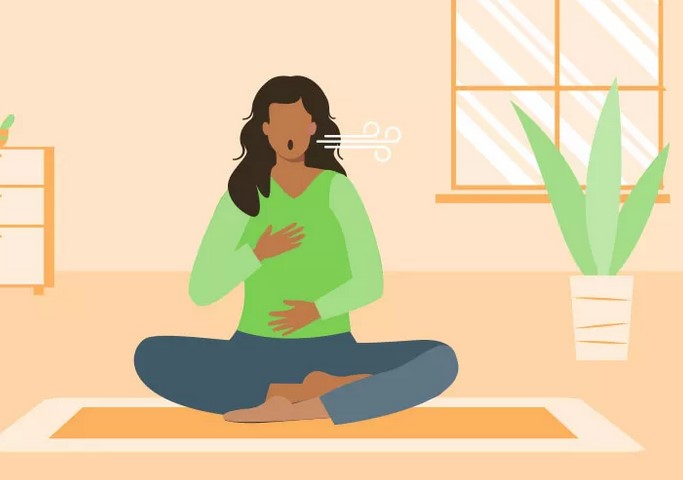
Place one hand on your chest and one on your belly.
-
Ensure the hand on your chest stays still while the hand on your belly rises on the inhale.
-
This engages the Diaphragm, massaging your internal organs and increasing lymphatic drainage.
Advanced Insights: The Emotional Release
In the intermediate stages of Breathwork for Healing, especially during “Circular” or “Holotropic” style sessions, you might experience what we call a “Release.” I’ve seen grown men weep and chronic pain sufferers find sudden relief during deep sessions. This happens because the body stores “somatic memories” of trauma. When we flood the system with oxygen and balance the nervous system, those physical “knots” often begin to untie.
Pro Tip: If you feel a “tingling” sensation in your hands (paresthesia) or a bit of lightheadedness during deep breathwork, don’t panic. This is a common result of $CO_2$ levels shifting. Simply return to normal nasal breathing, and it will subside in seconds.
Expert Advice: Common Pitfalls to Avoid
After a decade in this field, I see the same mistakes repeatedly. If you want real results, avoid these:
-
Mouth Breathing: Unless a specific technique calls for it, stay a “Nose Breather.” Your nose filters, warms, and humidifies the air while producing Nitric Oxide, a vasodilator that helps lower blood pressure.
-
Forcing the Breath: Healing doesn’t happen through aggression. If you find yourself straining or gasping, you are actually creating more stress.
-
Inconsistency: Breathing once a week won’t rewire your brain. Aim for 5 minutes, 3 times a day. Think of it as “Micro-dosing” peace.
Creating Your Daily Healing Ritual
You don’t need a yoga mat or a Himalayan salt lamp to practice. You can do this in your car, at your desk, or while waiting in line at the grocery store.
-
Morning: 5 minutes of Box Breathing to set a “calm-alert” baseline.
-
Mid-day: 2 minutes of Diaphragmatic breathing to clear the “brain fog” of the afternoon slump.
-
Evening: 5-10 minutes of the 4-7-8 technique to signal to your body that the “hunt” is over and it’s time to repair.
Final Thoughts: The Power is Literally Under Your Nose
We spend thousands of dollars on supplements, gym memberships, and therapy—all of which have their place. But we often overlook the one tool that is free, always available, and works faster than any pill.
Breathwork for Healing is about reclaiming your agency. It is a reminder that even when the world is chaotic, you have an internal “dial” that can bring you back to center.
I challenge you right now: Close your eyes. Take a deep, four-second inhale through your nose, feeling your belly expand. Hold it for a moment. Then, let out a long, slow sigh.
How do you feel?
If you’re ready to dive deeper into your wellness journey, I’d love to hear from you. Have you ever tried a specific breathing technique that changed your mood? Drop a comment below or share this with someone who needs a “deep breath” today!


