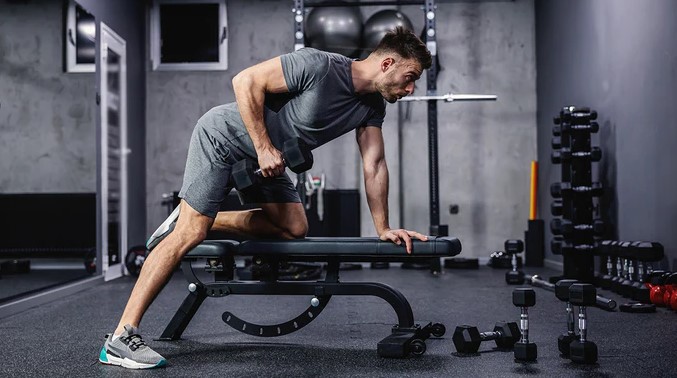
I’ve spent over a decade in humid, clanging gyms and high-end fitness studios, and I’ve noticed a recurring tragedy. I see beginners standing paralyzed in front of a massive, complex cable machine that looks like it belongs in a NASA laboratory. Meanwhile, the most powerful tool in the entire room—the humble pair of dumbbells—sits gathering dust in the corner.
In my early years as a trainer, I fell for the “fancy machine” trap too. I thought more pulleys meant more progress. But after working with hundreds of clients, from corporate athletes to busy parents, I’ve learned a truth that the fitness industry often hides: You can build a world-class physique, fix your posture, and skyrocket your metabolic rate with nothing more than two pieces of weighted iron and six square feet of floor space.
Why Dumbbells Are the Ultimate Fitness Equalizer
When you use a machine, the path of motion is fixed. The machine dictates how you move. With dumbbells, you are the pilot. This fundamental shift is why “free weights” are superior for functional health.
The “Unstable Table” Analogy
Think of a gym machine like a train on a track; it can only go forward and backward. Now, think of dumbbells like a helicopter. Because the weights are independent, your body has to engage tiny “stabilizer muscles” to keep them steady. It’s the difference between leaning against a wall (machine) and balancing on a surfboard (dumbbells). The latter forces your core and joints to work much harder, leading to a more “complete” kind of strength.
The Science-Backed Benefits of Training with Dumbbells
If you are looking to maximize your efficiency, here is why you should prioritize these weights in your next session:
-
Correction of Muscle Imbalances: We all have a dominant side. On a barbell bench press, your strong side often compensates for the weak one. With dumbbells, each arm must carry its own weight. This forces your “lazy” side to catch up, preventing long-term injury.
-
Increased Range of Motion (ROM): Unlike a barbell, which hits your chest before your muscles are fully stretched, dumbbells allow you to move past the torso. A deeper stretch equals more muscle fiber recruitment and better flexibility.
-
Joint Safety: Since your hands aren’t locked into a fixed position, you can rotate your wrists and elbows to find the path of least resistance. This is a game-changer for anyone with “clicky” shoulders or sensitive elbows.
Essential Exercises to Transform Your Body
To get the most out of your dumbbells, you don’t need fifty different movements. You need five or six “compound” movements—exercises that use multiple joints at once.
1. The Goblet Squat (Lower Body Dominance)
This is my favorite teaching tool for beginners. By holding one dumbbell against your chest like a “goblet,” you create a counter-balance that naturally fixes your posture.
-
Keep your elbows inside your knees at the bottom of the squat.
-
Drive through your heels to stand back up.
-
Benefit: Targets quads, glutes, and core stability simultaneously.
2. The Renegade Row (The Ultimate Core “Hack”)
Get into a plank position with your hands on the dumbbells. Row one weight up to your hip while keeping your pelvis perfectly still.
-
The Secret: Don’t let your hips rotate.
-
Benefit: This isn’t just a back exercise; it’s an anti-rotational core workout that builds a rock-solid midsection.
3. Overhead Press (Shoulder Health)
Stand tall and press the weights from your shoulders toward the ceiling.
-
-
Pro Tip: Squeeze your glutes. It sounds odd, but tightening your “butt” protects your lower back from arching too much during the lift.
-
Understanding the Technical Nuances: Mechanical Tension and Hypertrophy
To see real change, you need to understand Progressive Overload. Your body is an adaptive machine; if you lift the same 10lb dumbbells for six months, your body has no reason to grow.
You must consistently challenge your muscles through:
-
Mechanical Tension: Lifting heavier weights over time.
-
Metabolic Stress: Doing more repetitions or decreasing rest time (the “burn”).
-
Volume: The total amount of work (Weight x Reps x Sets).
Expert Advice: Tips Pro and Hidden Warnings
In my ten years of practice, these are the “insider” details that separate the pros from the amateurs:
Pro Tip: The “Crush” Grip
When doing chest presses or goblet squats, try to “crush” the dumbbells with your hands. This creates a phenomenon called irradiation—by gripping harder, you neurologically “switch on” more muscles in your arms and chest, making the lift feel lighter and more stable.
Hidden Warning: The Ego Trap
I often see intermediates grab the heaviest dumbbells on the rack and use “momentum” (swinging) to lift them. In the health world, we call this “cheating your gains.” If you have to swing your body to get the weight up, you aren’t training your muscles; you’re just testing your joints’ durability. Lower the weight, slow down the “eccentric” (lowering) phase, and feel the muscle work.
Designing Your “Minimum Effective Dose” Routine
You don’t need two hours in the gym. For a beginner-intermediate looking for wellness and muscle tone, try this 30-minute dumbbell circuit three times a week:
-
Goblet Squats: 3 sets of 12 reps.
-
Dumbbell Floor Press: 3 sets of 10 reps.
-
Single-Arm Rows: 3 sets of 10 reps per side.
-
Dumbbell Lunges: 3 sets of 8 reps per leg.
-
Overhead Press: 3 sets of 10 reps.
Rest: 60 seconds between sets. Focus on the quality of the movement, not the speed.
Final Thoughts: Simplicity is Sophistication
We live in an age of high-tech wearables and bio-hacking, but the most effective tool for human health remains a simple, weighted handle. Dumbbells allow you to move naturally, correct your posture, and build a body that is as functional as it is aesthetic.
I’ve seen people reclaim their mobility and lose thirty pounds using nothing but a pair of adjustable weights in their garage. The barrier to entry isn’t your membership fee or your equipment—it’s your consistency.
What’s holding you back from starting your strength journey today? Do you prefer working out at home or in a gym setting? Leave a comment below with your favorite dumbbell exercise, or ask me a specific question about your form!